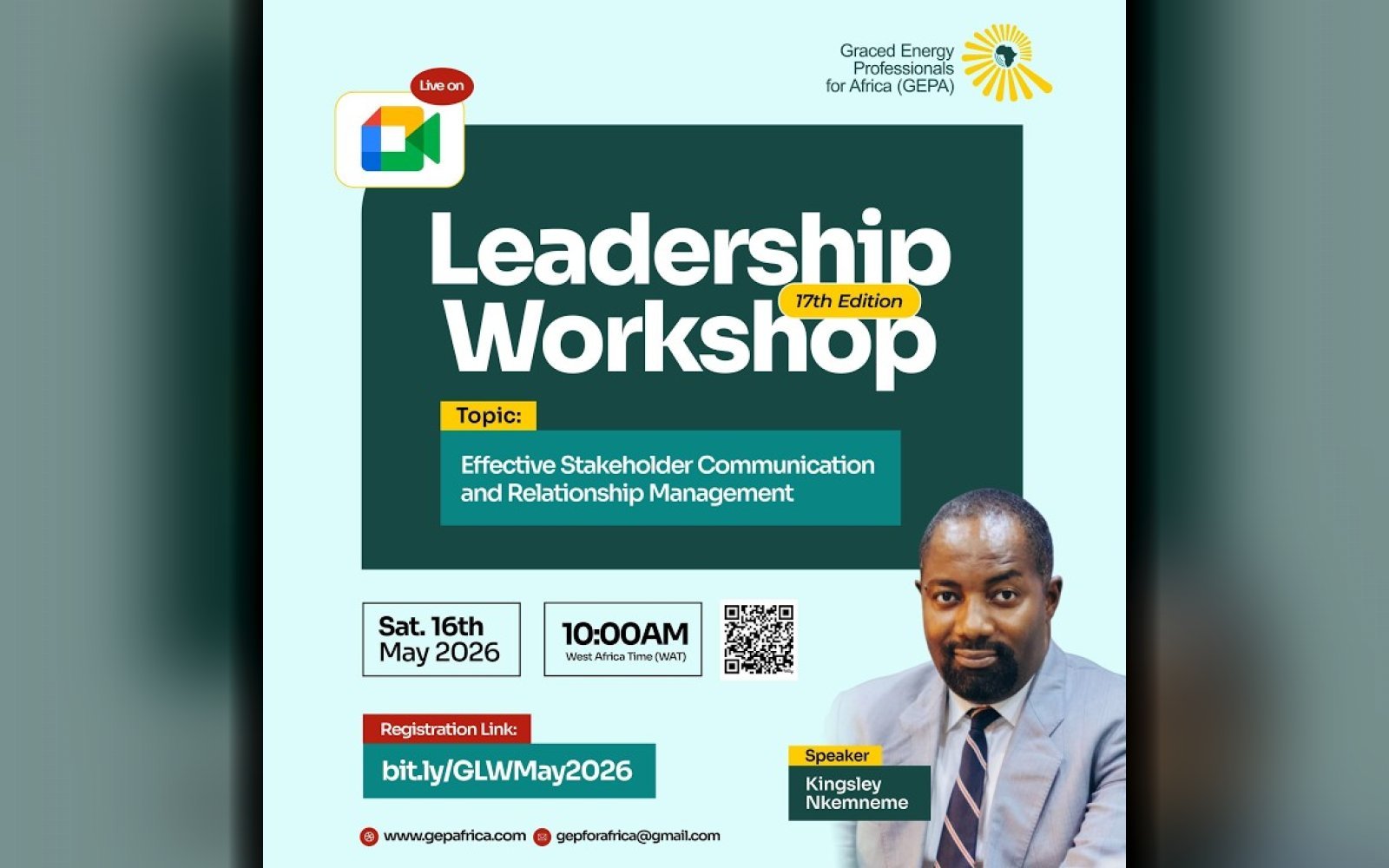
The inner game: why lasting results start with self-awareness
Dr Peter Emmanuel argues that most people try to change their results from the outside. The work, he says, starts with self-awareness, identity and mindset.

Most people do not choose a direction. They react. Finish the exam, then get married, then pick up a skill: each pressure is dealt with as it arrives, and the next one takes its place. Dr Peter Emmanuel, a medical doctor and personal transformation consultant who led GEPA's final leadership workshop of 2025, argues that this way of living stores up problems, and that trying to fix results from the outside never holds.
His alternative is personal development taken on deliberately, across the emotional, physical, spiritual and social areas of life. It is not a corporate fashion, he says. It is the move from reaction to intention.
The gap is a person, not a distance
Emmanuel calls the space between where you are and where your vision requires you to be the growth gap. Most people assume they close it by chasing the vision. He argues there is also someone you have to become, because you cannot rise beyond the level of your personal growth.
He compares it to software versions. Possibilities belong to a version of you, and wanting what version 5.0 has while running as version 1.0 will not work. So study how people at the level you want think, decide, work and spend their days.
Results are decided underneath
He separates the outer game of success, what you have and what happens around you, from the inner game: identity, mindset, habits and emotional mastery. Your present state is a function of the decisions you have taken, and those decisions come out of internal conditioning. On the iceberg model he uses, roughly eighty per cent of what controls your visible results sits below the surface.
That, in his view, is why lottery winners lose what they gained: nothing inside was conditioned to hold it. Patching the outside is like using correction fluid on a printed page, and the mark always shows. Correct the file and the next print comes out clean.
Self-awareness is the foundation
Emmanuel treats self-awareness as the foundation for everything else. You cannot change what you do not acknowledge. Speaking as a doctor, he insists no child is born with a mindset: what you heard, saw and experienced growing up conditioned you, and still does.
On the four levels of competence, the hardest place to help anyone from is unconscious incompetence: not knowing that you do not know. Self-awareness moves you to conscious incompetence, where you can finally name the gap, and practice does the rest, as anyone who has learned to drive will recognise.
The audit he recommends is a set of plain questions, answered by sitting down rather than staying busy:
- What are my thinking patterns?
- How do I make decisions?
- What are my core values and beliefs?
- What are my strengths and weaknesses?
- Who am I?
Failure, he adds, is an event, not an identity. The session is faith-informed: Emmanuel anchors identity in scripture and holds that it is received rather than achieved, so a season of failure cannot dismantle it.
Reprogramming what you were given
A mindset, he says, is your beliefs, attitudes and perspective grouped together. You reprogram it the same way it was programmed, by controlling what you hear, what you see and the environment you sit in. Unlearning is the hard part. If you do nothing about your environment, he warns, it is already doing something to you.
Intensity matters too. The degree of change is tied to the frequency and depth of exposure, so one book a month and four books a month will not give the same result. Challenged by his pastor to read as many books on finance as he had years of age, Emmanuel did it.
Asked from the floor about procrastination, he traced it back to identity. Techniques such as the five second rule are useful, he says, but the real issue is how you see yourself.
The full course, taught from the workshop recording, is in the catalogue. It also covers self-esteem, personality types, the subconscious and a question from the floor on why effort and results so often fail to match.